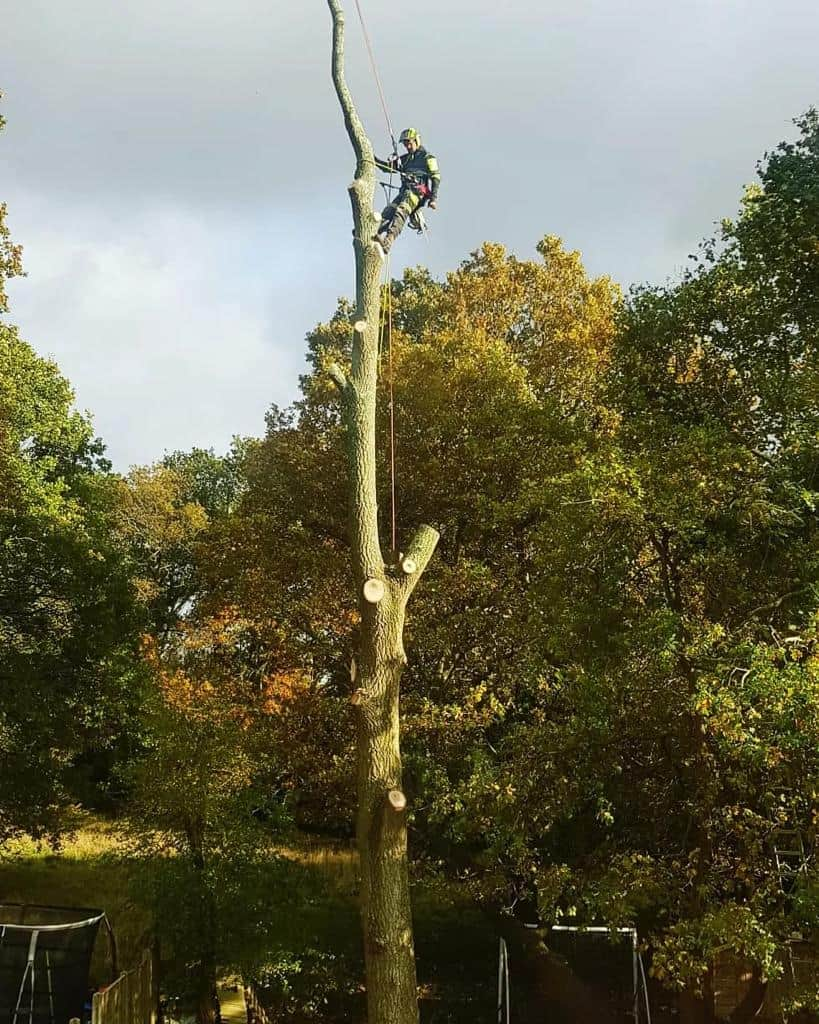
A mature tree can bring character, greenery and structure to a garden, but there can come a point when its size begins to create practical problems. An expanding canopy may dominate the available space, block natural light, overhang patios or other garden features, while low or spreading branches can make parts of the garden increasingly difficult to use.
When this happens, removing the tree is not automatically the best solution. Depending on its condition, size and position, professional pruning or crown reduction may be enough to bring the tree back into proportion with its surroundings. In other situations, removal may be the more practical long-term option.
For homeowners in Selsey, West Sussex, LM Tree Surgery Selsey can assess an overgrown tree and determine the most appropriate way to manage it without carrying out unnecessary work.
Why Do Trees Become Too Large for Their Surroundings?
Trees continue developing throughout their lives, and a tree that once fitted comfortably within a garden may eventually occupy considerably more space.
This can be particularly noticeable when a tree has received little management over many years.
Common signs that a tree is beginning to dominate its surroundings include:
- Branches spreading across large areas of the garden
- A dense canopy significantly reducing natural light
- Growth extending towards the property
- Low branches interfering with paths or seating areas
- The tree overshadowing other planting
- The crown becoming disproportionate to the available space
- Repeated branch clearance becoming necessary
The correct response depends on exactly what is causing the problem.
Option 1: Selective Tree Pruning
Pruning is often suitable when the tree itself is generally an appropriate size but particular branches are creating problems.
Rather than reducing the complete canopy, specific growth can be removed or shortened where appropriate.
When Might Pruning Be Suitable?
Selective pruning may be considered where:
- Individual branches are becoming overly long
- Low growth is restricting movement underneath
- Branches are interfering with particular garden areas
- Dead, damaged or unsuitable growth needs removing
- Certain parts of the canopy have become congested
The benefit of targeted pruning is that attention can be concentrated where it is genuinely required.
A tree should not necessarily receive extensive cutting simply because one section has become inconvenient.
Option 2: Crown Reduction
If the problem involves the overall dimensions of the canopy rather than a few individual branches, crown reduction may be more appropriate.
Crown reduction involves carefully reducing the height, spread or overall size of the canopy while aiming to retain a balanced and natural tree structure.
This can be useful where a mature tree has gradually become too large for the garden but remains suitable for retention.
What Can Crown Reduction Achieve?
Depending on the individual tree, reduction can help:
- Reduce excessive canopy spread
- Create greater separation from nearby features
- Make the tree more proportionate to the garden
- Reduce the dominance of an oversized crown
- Improve the relationship between the tree and surrounding outdoor space
The objective should be controlled management rather than simply cutting branches back as severely as possible.
Pruning and Crown Reduction Are Not the Same
Although the terms are sometimes used interchangeably, pruning and crown reduction can have different objectives.
Pruning is a broad term covering the selective removal of branches for particular reasons. It might concentrate on a small part of the tree.
Crown reduction is more specifically concerned with reducing the overall dimensions of the canopy.
Understanding the difference is important because an oversized tree may not be effectively managed by repeatedly cutting a handful of easily accessible branches.
Likewise, a tree with one problematic branch does not necessarily require its complete crown to be reduced.
What If the Main Problem Is Too Much Shade?
A large, dense tree can significantly change how a garden feels.
Lawns and planting areas may receive less sunlight, patios can remain shaded for much of the day, and rooms close to the canopy may become noticeably darker.
The appropriate tree work depends on why the shade has become excessive.
If the overall crown has become too broad, reduction may help. Where particular branches are responsible, selective pruning might provide a more focused solution.
It is worth keeping expectations realistic. A mature tree will naturally continue producing shade even after professional tree surgery. The aim is usually to create a better balance rather than eliminate shade completely.
What If Branches Are Growing Towards the Property?
Branches gradually extending towards the home are another common reason homeowners begin considering tree surgery.
The best time to address this is generally before growth becomes extremely extensive.
Professional pruning can create appropriate clearance while considering the structure of the tree as a whole. This is preferable to repeatedly cutting branch ends without considering how those cuts affect future growth and canopy balance.
Early management can also make ongoing maintenance more straightforward.
When Might Tree Removal Be the Better Option?
There are situations where pruning or crown reduction may not provide a satisfactory long-term solution.
Removal may deserve consideration where the tree’s position, condition or mature size means that retaining it is no longer practical.
For example, professional assessment may indicate removal where:
- The tree has become fundamentally unsuitable for its position
- Significant deterioration affects its condition
- Structural problems make retention inappropriate
- The tree has substantially outgrown the available space
- Repeated pruning cannot realistically resolve the underlying issue
- The tree is causing persistent practical problems throughout the garden
Tree removal should be considered on the basis of the individual circumstances rather than simply because the tree is large.
A Large Tree Does Not Automatically Need Felling
Size alone is not necessarily a reason to remove a tree.
Many mature trees can continue to make a valuable contribution to a garden when they are appropriately managed.
If pruning or crown reduction can resolve the main concerns while maintaining a suitable structure, retaining the tree may be the preferable approach.
This is why professional assessment is particularly valuable. It helps distinguish between a tree that simply needs sensible management and one that has genuinely become unsuitable for its surroundings.
Why Severe Cutting Is Not a Good Substitute for Proper Reduction
When a tree feels overwhelmingly large, it can be tempting to remove as much growth as possible in one attempt.
However, successful tree management is not about achieving the smallest possible canopy.
Excessive or poorly positioned cuts can leave a tree looking unbalanced and may encourage undesirable future growth. Different tree species also respond differently to pruning.
Professional reduction considers where cuts should be made and how much growth can appropriately be removed while retaining a suitable canopy.
Consider the Whole Garden Before Deciding
Tree surgery should not be considered in isolation from the surrounding outdoor space.
Before deciding whether to prune, reduce or remove a tree, it is useful to think about how the garden is actually used.
Consider questions such as:
- Which areas are being affected by the tree?
- Is the main concern shade, size or branch clearance?
- Are paths or seating areas becoming difficult to use?
- Is the tree overwhelming other planting?
- Is growth extending towards buildings or garden structures?
- Would retaining a smaller, managed canopy solve the problem?
Answering these questions helps establish what the tree work needs to achieve.
Can Tree Surgery Make a Garden Feel Larger?
Managing an oversized canopy can make a substantial visual difference.
A large tree with extensive low or lateral growth can make a garden feel enclosed. Bringing suitable sections of the canopy under control can restore clearer sightlines and create a better sense of space.
It can also allow lawns, planting and other garden features to become more visually prominent.
The tree can remain an important feature without dominating everything around it.
Why Regular Management Can Be Better Than Waiting
Trees continue growing after pruning, so professional tree surgery is not a permanent way of keeping a tree at exactly the same dimensions.
Where a tree naturally produces vigorous growth, periodic management may be beneficial.
Allowing the canopy to become severely overgrown before taking action can mean that more substantial work is eventually required.
Appropriate maintenance at sensible intervals can help keep the relationship between the tree and garden manageable over the longer term.
Why Professional Tree Surgery Matters
Working on a large tree requires more than simply identifying branches that appear inconvenient.
The structure, condition, species and growth pattern of the tree all need to be considered before work begins. Removing the wrong branches or taking away excessive growth can affect both appearance and future development.
Professional tree surgery aims to carry out the work necessary to achieve the desired improvement while avoiding unnecessary intervention.
This is especially important when deciding between pruning, crown reduction and complete removal because each option has a very different outcome.
Professional Tree Surgery in Selsey
At LM Tree Surgery Selsey, we provide professional tree surgery for homeowners throughout Selsey, West Sussex.
If a tree is beginning to dominate your garden, the first step is to determine whether the problem involves particular branches, the overall dimensions of the crown or the suitability of the tree itself.
Where appropriate, selective pruning or crown reduction may restore a much better balance without removing the tree. Where retention is no longer practical, professional tree removal may provide the more suitable solution.
Conclusion
When a tree starts taking over the garden, there is no single solution that is right in every situation.
Selective pruning can address individual problematic branches, while crown reduction can bring an oversized canopy back into better proportion with its surroundings. Tree removal may be appropriate where the tree’s condition, position or mature dimensions mean that ongoing pruning is unlikely to provide a practical long-term answer.
For homeowners in Selsey, West Sussex, LM Tree Surgery Selsey can assess an overgrown or dominant tree and recommend an appropriate approach based on its actual condition and surroundings. If a tree is restricting light, overwhelming your garden or becoming increasingly difficult to manage, professional assessment can help determine whether pruning, reduction or removal is the most suitable next step.
Call us on: 01243 217 387
Click here to find out more about LM Tree Surgery Selsey
Click here to complete our contact form and see how we can help with your tree needs.